What’s wrong with my door?
Pick what your door is doing. You’ll see what usually causes it, what’s safe to check yourself, and what to leave to us.
Before you check anything
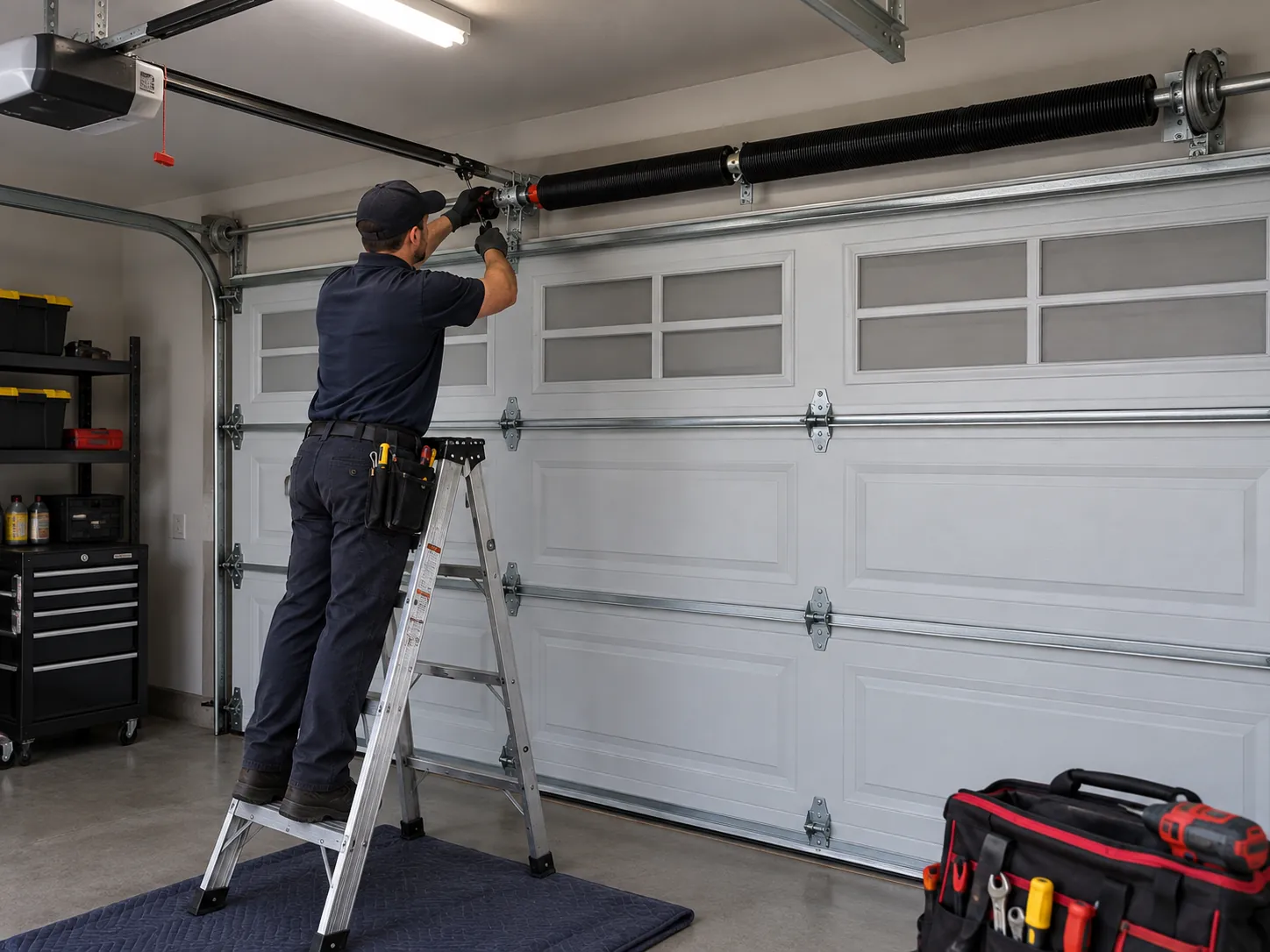
- Leave springs and cables alone. They’re under high tension and can cause serious injury.
- Keep clear of a stuck or crooked door. Keep people, pets and cars out from under it until it’s fixed.
Pick what your door is doing
Not sure which one?
Pick the closest match, or call and describe what’s happening.
Likely cause
Often a broken spring or a problem with the opener.
The springs do the heavy lifting. When one breaks, the door is too heavy for the opener to lift, so it stays shut. An opener that has lost power or failed does the same.
Safe to check yourself
- Check the opener is plugged in and its light comes on.
- Try the wall button as well as the remote, and change the remote’s batteries.
- Look, without touching, at the spring above the door. A broken one often has a clear gap in the coil.
Leave to us
- Don’t lift the door by hand or keep pressing the button if a spring looks broken.
- Never adjust, unwind or replace a spring yourself.
Likely cause
Often worn rollers, or a spring that’s close to failing.
Noise is usually an early warning. Worn rollers grind in the tracks, and a tired spring can bang or creak before it gives.
Safe to check yourself
- Watch the door move and notice where the noise comes from: the rollers, the opener or the spring.
- With the door closed, check the tracks for anything caught in them, like leaves or a small toy.
Leave to us
- Don’t touch, tighten or adjust the springs or cables.
- If you heard one loud bang with nobody using the door, a spring may have snapped. Leave the door closed and call us.
Likely cause
Often a snapped cable.
Each side of the door hangs on a cable. When one snaps, that side drops, the door tilts, and it can come off its track.
Safe to check yourself
- Stop using the door, and keep people, pets and cars out from under it.
- Unplug the opener so nobody presses the button by mistake.
Leave to us
- Don’t push the door back onto its track or try to straighten it.
- Never touch the cables or the brackets at the bottom corners of the door. They’re under high tension.
Likely cause
Often a stripped gear inside the opener.
The motor turns, but the worn gear can’t pass that movement on to the door, so you hear the opener running and nothing happens.
Safe to check yourself
- Check the emergency release, the cord hanging from the opener rail. If it has been pulled, the opener runs without moving the door. Your opener’s manual shows how to reconnect it.
- Notice whether the motor hums, clicks or runs normally. It helps us bring the right parts.
Leave to us
- Don’t take the opener’s cover off or open it up.
- Don’t pull the emergency release while the door is open. If a spring is broken, the door can drop fast.
Likely cause
Often the safety sensors are blocked or out of line.
The door has 2 small sensors near the bottom of its tracks that watch the doorway. If something blocks them, or one gets knocked out of line, the door reverses to be safe.
Safe to check yourself
- Move anything near the sensors, like bins, bikes or plants.
- Wipe the sensor lenses with a soft, dry cloth.
- Most sensors have a small light. If one is off or blinking, gently turn that sensor until it lines up with the other.
Leave to us
- Never disconnect or bypass the sensors to make the door close. They stop it closing on a person, pet or car.
- Don’t change the opener’s force settings.
Something else going on?
Leave the springs to us.
Never try to replace or adjust a garage door spring yourself. They are under high tension and can cause serious injury.
If you think a spring has broken, don’t force the door. Call (813) 555-0177 instead.